Restaurant Receipt for Taxes: Business Meal Deduction Guide
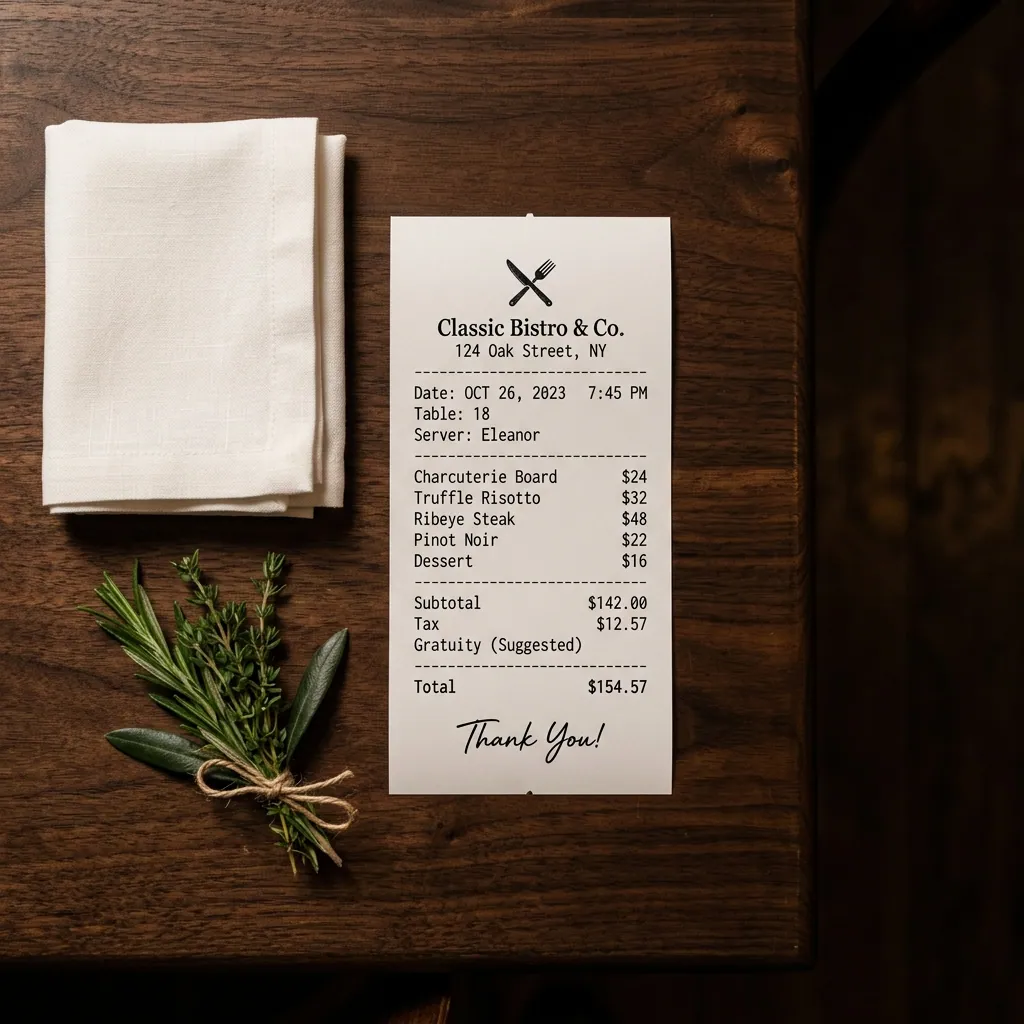
Ready to create your own? Use our free receipt generator — no account needed.
Generate Restaurant Receipt Generator →On this page
The 50% business meal deduction is one of the most commonly claimed — and most commonly audited — self-employment deductions. The IRS is specific about what documentation is required. Here's exactly what your restaurant receipt needs, what qualifies, and how to document client meals correctly.
Quick Answer
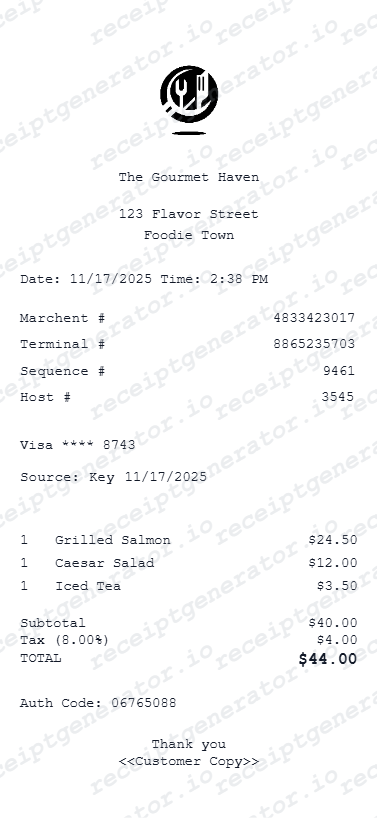
Your restaurant receipt needs: restaurant name, date, itemized food and drinks, and the total. You must separately record: who you dined with, their company/role, and the specific business purpose of the meal. The IRS requires both the receipt AND these written notes.
The Business Meal Deduction: 50% Rule
Under current IRS rules (as of 2024):
- 50% deductible: Business meals with a bona fide business associate when there is a clear business purpose
- 100% deductible: Meals provided to employees for the employer's convenience on business premises
- 0% deductible: Entertainment (sporting events, concerts, club memberships) — these were eliminated in 2018
- 0% deductible: Meals that are "lavish or extravagant" (though the IRS rarely defines this precisely)
The deduction goes on Schedule C (Line 24b) for sole proprietors, or the appropriate expense category for partnerships and S-corps.
What the IRS Requires on a Business Meal Receipt
Per IRS Publication 463, Section 2, an adequate restaurant receipt must include:
Restaurant Receipt Requirements
| Feature |
|---|
The last two items (business purpose and attendees) are often not on the restaurant receipt — you need to add them yourself. Write them on the back of the paper receipt, or keep a contemporaneous expense log.
How to Document a Business Meal Correctly
At the restaurant:
- Request an itemized receipt (not just the credit card slip) — in most restaurants, this is the check presented before payment
- Pay with a business credit card — this creates a bank record to support the receipt
After the meal:
- Write on the back of the receipt (or in your expense app):
- Who attended: "John Smith, Director of Sales at Acme Corp"
- Business purpose: "Discussed Q2 partnership proposal and contract terms"
- If using an expense app (Expensify, Wave, Zoho), attach the photo and add notes in the description field
Digital delivery or food platforms:
If the meal was ordered via Uber Eats, DoorDash, or Grubhub for a business meeting, the digital order receipt is acceptable as documentation — add the business purpose separately. See DoorDash Receipt for Drivers and Customers for retrieving digital order receipts.
Which Meals Qualify as Business Meals
Qualify (50% deductible):
- Client dinners with a clear business discussion
- Meals with business partners, investors, or vendors
- Team meals during a business day (with legitimate purpose)
- Travel meals (away from tax home overnight or longer)
- Meals at a conference or business training event
Do not qualify:
- Meals with friends or family (no business purpose)
- Solo lunch at your desk when not traveling
- Client entertainment (tickets, drinks-only with no food)
- Meals that are "primarily social" without documented business discussion
Restaurant Receipt for Different Meal Types
Sit-Down Restaurant
Standard itemized receipt covers everything. Write attendee and purpose on the back.
Food Delivery (Uber Eats, DoorDash, Grubhub)
The order confirmation email is your receipt — download it as PDF. Add business purpose in a written note.
Coffee Meetings
Coffee shop receipts are fine for business meal deductions when meeting a client. Keep the itemized receipt (not just the card slip) and note who you met and why.
Business Travel Meals
Meals while traveling for business (away from home overnight) are deductible at 50% even if you dine alone. Note the city and business purpose of the trip.
Related:
- How to Get a Restaurant Receipt
- Lost Restaurant Receipt
- Restaurant Receipt for Reimbursement
- How to Get a McDonald's Receipt
- McDonald's Receipt for Reimbursement
- Gas Receipt for Taxes: IRS Requirements & How to Recreate One
- Hotel Invoice Generator: Replace a Lost Hotel Receipt
- How to Make a Receipt for Taxes: Complete IRS Guide
- Lost Uber Receipt: How to Get an Uber Receipt for Reimbursement
Using a Restaurant Receipt Generator for Lost Receipts
If your original restaurant receipt is lost:
- Check your card statement — the amount, date, and restaurant name are there
- Check your email — if you booked via OpenTable or Resy, there's often a payment confirmation
- Check the restaurant's system — high-end restaurants often keep records; call and explain
- Reconstruct the receipt — use the Restaurant Receipt Generator with verified details from your card statement
A reconstructed receipt based on verifiable data is far better documentation than nothing. The IRS allows reconstructed records when originals are lost involuntarily.
Generate a Restaurant Receipt | Fine Dining Receipt | Fast Food Receipt
Restaurant Receipt for Business Expense Report
If you're an employee submitting a restaurant receipt for reimbursement:
Most expense systems (SAP Concur, Expensify, Zoho Expense) require:
- Itemized receipt photo
- Total amount
- Business purpose entered in the description field
- Names of attendees (often required for meals over $25)
- Receipt date matches the expense report period
Submit within the company's window (usually 30-60 days). Late submissions may not be reimbursable.
Official IRS Reference
Quick Reference: Meal Deduction Rules
Meal Deduction Scenarios
| Feature |
|---|
FAQ
Yes — the IRS allows a 50% deduction for business meals when the meal has a clear business purpose and a business associate is present.
Entertainment expenses (sporting events, concerts) are no longer deductible as of the 2018 Tax Cuts and Jobs Act — only meals qualify.
The restaurant name and address, date, itemized food and drinks (not just the total), and number of people.
You must also record (separately or on the receipt) the business purpose and the names/business relationship of everyone at the meal.
Yes — the IRS requires an itemized receipt showing individual food and drink items, not just the total charged to your card.
Credit card statements alone are not sufficient documentation for meals over $75.
Solo meals while traveling for business (away from your tax home overnight) are 50% deductible.
Solo meals at your regular place of business are generally not deductible — there must be a business purpose and usually another person present.
Yes — the tip is part of the meal expense and is included in the 50% deductible amount.
Non-cash tips paid at the table are included in the total you deduct.
For amounts over $75, the IRS requires documentary evidence — a bank/card statement alone is not enough.
You can reconstruct the receipt using: the credit card statement (date, amount, restaurant), a food delivery app record (if applicable), or a contemporaneous notes entry.