Gas Receipt for Taxes Guide
Ready to create your own? Use our free receipt generator — no account needed.
Generate Gas Receipt →On this page
Missing a gas receipt for taxes? You are not alone. Gas receipts are among the most commonly lost receipts for self-employed workers, freelancers, and anyone who drives for business. The good news: there are clear IRS rules on what you need — and in many cases, you may need less paperwork than you think.
If you drive your personal vehicle for business purposes, recovering those costs is one of the most valuable deductions you can claim. However, the exact documentation you need depends entirely on which accounting method you use to claim your vehicle expenses.
In this comprehensive guide, we will break down exactly what the IRS requires for a gas receipt for taxes, how the two main deduction methods affect your recordkeeping, and what to do if you are missing those crucial slips of paper when tax season arrives.
Quick Answer
Use the standard mileage rate and you won't need gas receipts at all — just a mileage log. Use the actual expense method and you'll need itemized receipts showing station, gallons, price, and total.
Important Notice
Replacement receipts are for personal recordkeeping only. For official tax filings, follow your accountant's guidance. When in doubt, consult a CPA before submitting reconstructed records to any tax authority.
Does the IRS Accept Gas Receipts for Tax Deductions?
Yes — gas is a highly scrutinized but fully deductible vehicle expense if it relates directly to business use. Commuting to and from your regular office does not count, but driving to client meetings, job sites, and picking up supplies absolutely does.
The IRS allows two distinct methods for deducting car expenses, and your requirement to keep gas receipts depends entirely on which method you choose:
- Standard mileage rate — you deduct a flat, per-mile rate for every mile driven for business (67 cents/mile for the 2024 tax year). With this method, no individual gas receipts are needed. You simply need a contemporaneous (meaning updated regularly) mileage log with dates, destinations, and a clear business purpose for each trip.
- Actual expense method — you calculate and deduct the literal, real-world cost of operating your vehicle. This includes gas, oil changes, insurance, depreciation, lease payments, and repairs, multiplied by your business-use percentage. This method absolutely requires itemized gas receipts for every fill-up.
Most self-employed people and freelancers get a better deduction (with far less administrative headache) using the standard mileage rate, which conveniently eliminates the need to keep track of individual gas receipts.
Gas Expenses as a Self-Employed Deduction vs. the Mileage Method
If you are a sole proprietor, freelancer, or gig worker (like an Uber driver or DoorDash delivery partner), you report your vehicle expenses on Schedule C of your Form 1040. The method you select to calculate these expenses matters deeply for your bottom line and your filing requirements:
- Standard mileage: This is simpler and requires only a mileage log. It tends to work best for high-mileage drivers operating fuel-efficient or fully depreciated vehicles. Because the flat rate factors in gas, wear and tear, and insurance, you do not need to present gas receipts.
- Actual expenses: This can yield a higher potential deduction for vehicles with very high operating costs (such as a large truck or older SUV), or if you acquired an expensive new vehicle and want to accelerate depreciation. However, the IRS demands strict proof. It requires receipts for every gas fill-up, every oil change, and every maintenance bill.
Important Note: You cannot easily switch between methods. If you want to use the standard mileage rate, you must choose to use it in the very first year you place the vehicle in service for your business. If you start with the actual expense method, you are generally locked into that method for the life of that specific vehicle.
What Happens if You're Audited and Missing Gas Receipts?
If the IRS audits your return and you claimed deductions using the actual expense method, you must produce your receipts. Without them, the auditor has the authority to disallow the deduction in full, leading to a higher tax bill plus potential penalties and interest.
However, the IRS does understand that paper fades, gets wet, or gets lost. If you are missing the original printed receipts, providing secondary supporting documents can often help reconstruct your records and satisfy an auditor:
- Bank or credit card statements showing the precise transaction amount, date, and gas station name.
- Fleet card statements if you use a dedicated fuel card (like a WEX or Fuelman card).
- Loyalty program history (such as ExxonMobil Rewards, Shell Fuel Rewards, or GasBuddy).
While a credit card statement isn't technically an "itemized receipt," combining your statement total with a reliable historical price-per-gallon source (like the U.S. Energy Information Administration weekly average) allows you to recreate the key figures for a comprehensive personal backup receipt.
Helpful official references:
The 6 Details That Matter for a Gas Receipt for Taxes
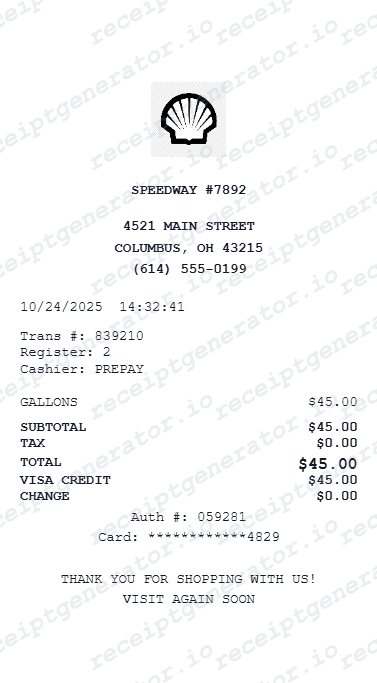
Whether you are recreating a receipt for your personal digital archives or just want to know what to look for when you pump gas, these are the six critical fields that make a receipt valid for accounting purposes:
- Station name and address (to prove the purchase occurred during a business trip)
- Date and time of purchase (must align with your business activities)
- Fuel type (unleaded, premium, diesel)
- Gallons or liters purchased
- Price per gallon
- Total amount charged + payment method (showing how you paid)
How to Reconstruct a Lost Gas Receipt Using Your Bank Statement
If you need a physical or PDF copy of a gas purchase to satisfy your bookkeeping software or your accountant's requirements, you can build a personal backup that reflects the reality of the transaction. Here is the step-by-step process:
- Pull the transaction total from your business bank or credit card statement.
- Find the average local fuel price for that specific date. You can use historical data from EIA.gov or GasBuddy.
- Calculate the volume by dividing your total charge by the price per gallon to estimate the exact gallons pumped.
- Build a simple, accurate receipt with the station name exactly as it appears on your statement.
- Save the generated PDF to your permanent tax folder and label it clearly with the date and amount.
Need a Gas Receipt for Your Records?
Don't let lost receipts ruin your deductions. Create a clean, professional gas or fuel receipt in seconds.
Gas Receipt Template: What Each Line Should Say
A standard Point of Sale (POS) gas receipt keeps it short and strictly to the numbers. Here is what a clean, realistic format looks like:
SHELL #4782  1428 W BROADWAY
DATE: 03/15/2024   TIME: 08:42 AM

UNLEADED  10.215 GAL  @ $3.49/GAL
SUBTOTAL  $35.65
TAX       $0.00
TOTAL     $35.65

VISA **** 4521
AUTH: 098342
When recreating documents for your records, keeping the font consistent (usually a monospaced thermal printer style font), ensuring totals are right-aligned, and avoiding adding information that does not normally appear on a standard POS terminal receipt are best practices.
Gas Receipt vs. Mileage Log: Which Is Better for Taxes?
For the vast majority of self-employed individuals and small business owners, the mileage log wins. Here is a quick breakdown of why many accountants recommend the mileage method over tracking actual gas receipts:
Gas Receipts vs. Mileage Log
| Feature |
|---|
The IRS requires mileage logs to be detailed. At a minimum, your log must include the date, destination, a specific business purpose (e.g., "Meeting with Client A regarding Q3 marketing"), and the number of miles driven.
Quick Storage Tip to Avoid Faded Receipts
Paper gas receipts are printed on thermal paper. They fade completely white within a few months, especially if left in a hot car. Take a photo immediately from your driver's seat and store it in a cloud folder organized chronologically by month. Mobile apps like Expensify, Wave, QuickBooks Self-Employed, or even a simple dedicated folder in Google Drive or Apple Notes work exceptionally well for ongoing receipt capture.
If You Track Mileage Instead
As emphasized, mileage logs frequently replace the need entirely for individual gas receipts. If you use an automatic mileage tracking app (such as MileIQ, Everlance, Hurdlr, or Stride), it will use your phone's GPS to classify drives. Keep the log consistent by reviewing your drives weekly and backing up the CSV or PDF reports monthly. The comprehensive log itself serves as your primary tax documentation, rendering individual gas station prints unnecessary.
If You Use a Fleet Card or Company Card
For businesses with multiple vehicles or higher commercial fuel volume, adopting a fleet card simplifies the tax receipt problem entirely. Fleet card statements automatically capture and itemize fuel purchases — including station location, exact gallons, fuel grade, and price per gallon — all aggregated into one consolidated monthly statement.
For IRS documentation requirements, this level II and level III credit card data usually satisfies the receipt requirement without you ever having to ask the attendant for a paper copy. Simply retain your digital statements and cross-reference them with your overall mileage log at year's end.
Related Tools & Guides
Gas & Fuel Generators:
- Gas Receipt Generator
- Gas Pump Receipt Generator
- Fuel Receipt Generator
- Oil Change Receipt Generator
- EV Charging Receipt Generator
Tax & Business Expense Guides:
- Gas Receipt Lookup
- Lost Gas Receipt
- Gas Receipt for Reimbursement
- Gas Receipt vs Invoice
- Printable Gas Receipt PDF
- How to Make a Receipt for Taxes: Complete IRS Guide
- Restaurant Receipt for Taxes: Business Meal Deduction Guide
- Hotel Invoice Generator: Replace a Lost Hotel Receipt
- Lost Uber Receipt: App, Email & Backup Options
Browse All Receipt Templates:
Official References
FAQ
If you use the standard mileage rate, you do not need individual gas receipts — your mileage log is enough.
If you use the actual expense method, you need receipts for gas, oil, insurance, and other car costs.
Keep dated receipts showing the station name, gallons, price per gallon, and total.
Credit card statements can support your records but are not a substitute for itemized receipts.
Only the business-use portion is deductible.
If you use your car 60% for business, only 60% of your gas costs can be deducted.
Credit card statements show the total paid but not the gallons or fuel type.
For the actual expense method, IRS auditors typically want itemized receipts, not just card statements.
Often no, but confirm with your tax professional.
Yes, if you use a realistic price per gallon and keep it consistent.